
The Role of AI in Revolutionizing Project Management: Benefits, Applications, and Future Prospects
By automating routine tasks, providing data-driven predictions, and enhancing decision-making, AI is not just a tool but a strategic partner that amplifies human capabilities in delivering successful outcomes. This article explores the multifaceted role of AI in project management, its key benefits, practical applications, potential challenges, and what the future holds for this dynamic integration.
Task Automation and Workflow Streamlining
AI excels at handling repetitive administrative tasks, such as scheduling meetings, generating reports, and tracking progress updates, freeing up project managers to focus on high-value activities like strategy and team leadership. Tools powered by AI can automatically assign tasks based on team members’ skills and workloads, reducing bottlenecks and improving overall workflow efficiency.
For instance, AI-driven dashboards provide visual overviews of project status, making it easier to monitor key metrics at a glance.
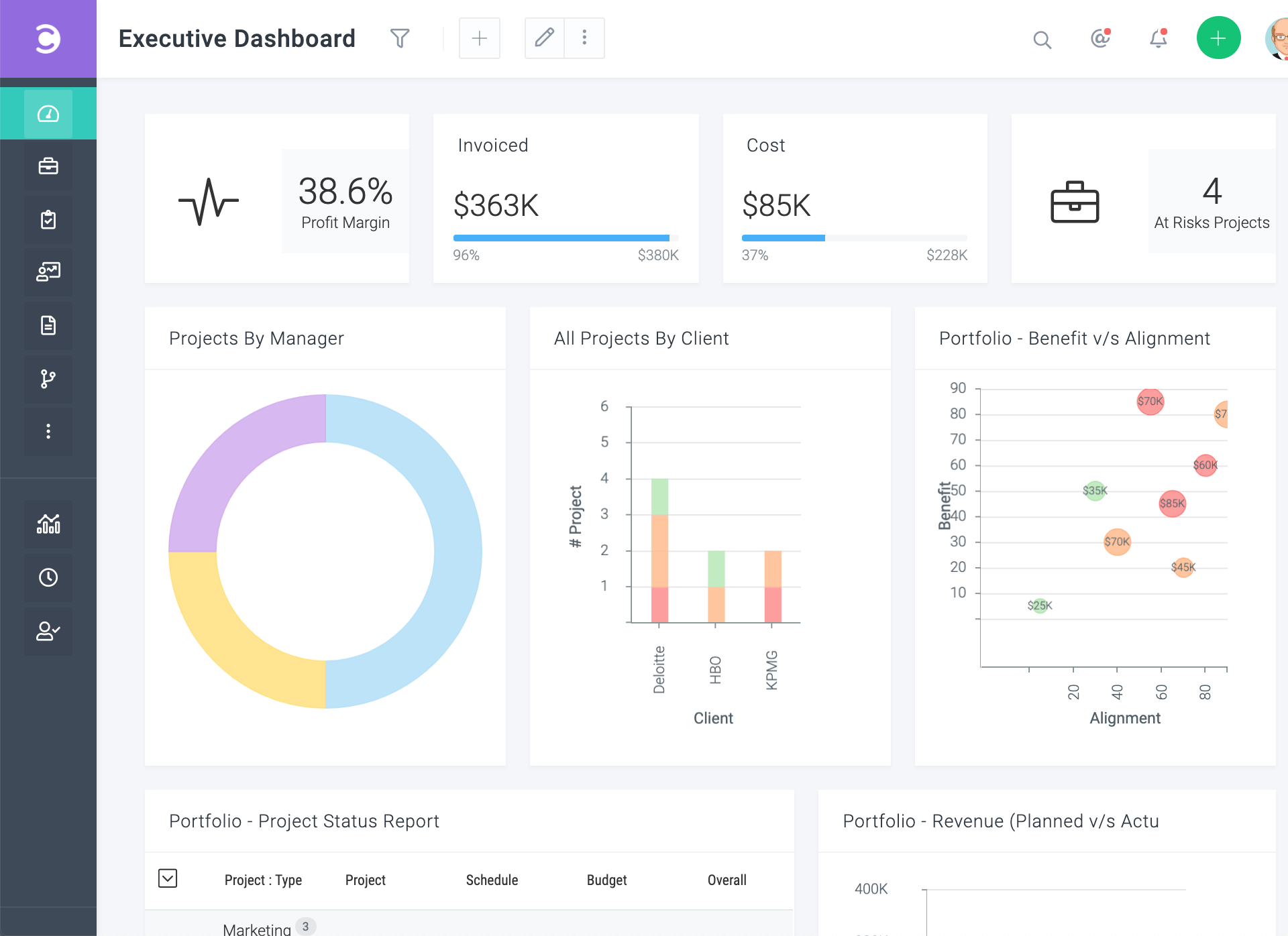
10 Best AI Project Management Tools for Project Managers – Celoxis®
Predictive Analytics and Risk Management
One of AI’s most powerful applications is in forecasting project outcomes. By analyzing historical data and current variables, AI can predict potential delays, budget overruns, or risks, allowing managers to implement mitigation strategies early. This empirical approach minimizes uncertainties in complex projects and enhances decision-making around resource allocation and timelines.
Resource Optimization
AI algorithms optimize resource distribution by evaluating project requirements against available assets, ensuring the right people and tools are assigned to the right tasks. This not only balances workloads but also prevents burnout and maximizes productivity across teams.
Visual representations, such as interactive dashboards, help illustrate these optimizations in real-time.

The 6 best AI project management tools in 2026
Enhanced Communication and Collaboration
AI facilitates better team interactions through virtual assistants that handle reminders, summarize meetings, and even translate communications in multicultural teams. Natural language processing enables chatbots to answer queries instantly, fostering a more collaborative environment.
Data-Driven Decision-Making
By sifting through large datasets, AI provides actionable insights that inform strategic choices, from prioritizing projects to adjusting scopes based on emerging trends.
The Benefits of Integrating AI into Project Management
The adoption of AI brings tangible advantages that can significantly elevate project performance. Below is a summary of key benefits, supported by industry insights:
| Benefit | Description | Impact |
|---|---|---|
| Increased Efficiency | Automates manual tasks, reducing time spent on administration and allowing focus on strategic work. | Teams report up to 61% on-time delivery with AI versus 47% without. |
| Cost and Time Savings | Predictive tools identify inefficiencies early, minimizing waste and overruns. | Leads to better ROI and benefits realization. |
| Improved Risk Mitigation | Analyzes data to foresee issues, enabling proactive interventions. | Reduces project failure rates and enhances success. |
| Enhanced Decision-Making | Provides real-time insights and analytics for informed choices. | Drives agility and innovation across organizations. |
| Better Resource Utilization | Optimizes allocation based on data, preventing overloads. | Boosts team productivity and satisfaction. |
These benefits collectively contribute to higher project success rates, with organizations leveraging AI experiencing improved precision, quality, and customer satisfaction.
Challenges and Considerations
While AI offers immense potential, it’s not without hurdles. Implementation can face resistance due to concerns over data privacy, the need for upskilling teams, and integration with existing systems. Additionally, AI’s effectiveness depends on high-quality data; poor inputs can lead to inaccurate predictions. Organizations must also address ethical issues, such as bias in algorithms, to ensure fair outcomes.
To overcome these, starting with pilot projects and investing in training is recommended.
Implementing AI in Your Projects
To harness AI effectively:
- Assess your current processes to identify areas ripe for automation.
- Choose user-friendly AI tools like Microsoft Project with AI features or Asana’s AI enhancements.
- Train your team on AI usage to build buy-in.
- Monitor and iterate based on performance metrics.
Modern AI interfaces often feature intuitive dashboards that simplify adoption.

Revolutionize Dashboard Design with AI-Driven Wireframes in MockFlow
Future Outlook
Looking ahead to 2026 and beyond, AI is poised to become even more integral, with advancements in generative AI enabling automated project planning and virtual reality simulations for training. As adoption grows, expect AI to bridge gaps in hybrid work environments, further elevating project management from tactical to strategic levels.
Conclusion
AI is reshaping project management by turning data into actionable intelligence, automating the mundane, and empowering teams to achieve more with less. The benefits—ranging from efficiency gains to risk reduction—make it an essential evolution for any organization aiming to thrive in a competitive landscape. By embracing AI thoughtfully, project managers like you, Arthur, can unlock new opportunities for innovation and success in Emerald Lakes or beyond.